
HealDA#
- class earth2studio.models.da.HealDA(
- model,
- condition,
- era5_mean,
- era5_std,
- sensor_stats,
- lat_lon=False,
- output_resolution=(181, 360),
- time_tolerance=(numpy.timedelta64(-21, 'h'), numpy.timedelta64(3, 'h')),
- GlobalDA202640 GB
HealDA data assimilation model for global weather analysis from sparse observations on a HEALPix grid.
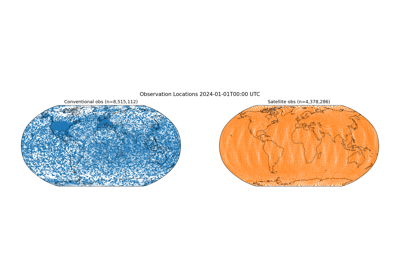
HealDA is a stateless assimilation model that produces a single global weather analysis from conventional and satellite observations. It operates on a HEALPix level-6 padded XY grid and outputs ERA5-compatible atmospheric variables.
The model accepts pre-processed observation DataFrames (from
earth2studio.data.UFSObsConvandearth2studio.data.UFSObsSat) and produces a global analysis field.- Parameters:
model (torch.nn.Module) – The underlying HealDA neural network
condition (torch.Tensor) – Static conditioning fields (e.g. orography, land fraction) on the HEALPix grid of size [1, n_static, 1, npix]
era5_mean (torch.Tensor) – ERA5 per-channel mean for output denormalization [1, out_variables, 1, 1]
era5_std (torch.Tensor) – ERA5 per-channel std for output denormalization [1, out_variables, 1, 1]
sensor_stats (dict[str, dict[str, np.ndarray]]) – Per-sensor normalization statistics loaded from the package
lat_lon (bool, optional) – If True the model output is regridded from the native HEALPix grid to a regular equiangular lat-lon grid using
earth2grid. If False the raw HEALPix output is returned with annpixdimension, by default Falseoutput_resolution (tuple[int, int], optional) –
(nlat, nlon)size of the output lat-lon grid. Only used whenlat_lon=True, by default(181, 360)(1° resolution)time_tolerance (TimeTolerance, optional) – Time tolerance for filtering observations, by default (-21 hours, 3 hours)
- __call__(conv_obs=None, sat_obs=None)[source]#
Run HealDA inference from conventional and/or satellite observations.
At least one of the two observation DataFrames must be provided. Each DataFrame must carry a
request_timeentry in its.attrs.- Parameters:
conv_obs (pd.DataFrame | None, optional) – Conventional observation DataFrame from
earth2studio.data.UFSObsConv, by default Nonesat_obs (pd.DataFrame | None, optional) – Satellite observation DataFrame from
earth2studio.data.UFSObsSat, by default None
- Returns:
Global analysis on the HEALPix grid with dimensions [time, variable, npix]. Data is on the same device as the model (cupy array for GPU, numpy for CPU).
- Return type:
xr.DataArray
- Raises:
ValueError – If both conv_obs and sat_obs are
None
- create_generator()[source]#
Creates a generator which accepts collection of input observations and yields the output global assimilated data.
- Yields:
xr.DataArray – Global analysis on the HEALPix grid
- Parameters:
None (tuple[pd.DataFrame |) – A
(conv_obs, sat_obs)tuple sent viagenerator.send(). Either element may beNonebut not both.None] (pd.DataFrame |) – A
(conv_obs, sat_obs)tuple sent viagenerator.send(). Either element may beNonebut not both.
- Return type:
Generator[DataArray, tuple[DataFrame | None, DataFrame | None], None]
- classmethod load_default_package()[source]#
Load the default HealDA model package from HuggingFace.
- Returns:
Model package pointing to the HuggingFace repository
- Return type:
- classmethod load_model(
- package,
- lat_lon=False,
- output_resolution=(181, 360),
- time_tolerance=(numpy.timedelta64(-21, 'h'), numpy.timedelta64(3, 'h')),
Load HealDA model from package.
- Parameters:
package (Package) – Package containing model checkpoint and statistics
lat_lon (bool, optional) – If True the output is regridded to a regular lat-lon grid, by default False
output_resolution (tuple[int, int], optional) –
(nlat, nlon)size of the output lat-lon grid. Only used whenlat_lon=True, by default(181, 360)time_tolerance (TimeTolerance, optional) – Time tolerance for filtering observations, by default (-21 hours, 3 hours)
- Returns:
Loaded HealDA assimilation model
- Return type:
AssimilationModel