

ik_target_reach (FET022 Driven Joints)#
Property |
Value |
|---|---|
Test name |
ik_target_reach |
Feature(s) |
FET_022_PHYSX, FET_022_NEWTON, FET_022_ISAAC |
Engine |
Kit / Isaac Sim (>=2024.2.0) |
Test version |
1.2.0 |
Summary#
Generates a Fibonacci-sphere distribution of end-effector targets, solves them with the Lula IK solver, commands the articulation to each solution, and verifies that the achieved end-effector pose is within the declared tolerances.
What Pass Guarantees#
A passing result confirms that the Lula IK solver can find valid joint configurations for reachable targets, that the articulation can execute those configurations, and that the achieved end-effector pose matches the commanded pose within the declared position and orientation tolerances. Reviewers, PMs, and OEMs can trust that the robot descriptor is correctly paired with the asset and that end-effector targets within the workspace are reachable in simulation.
What It Checks#
The test generates candidate end-effector targets distributed on a Fibonacci
sphere around the robot base. From those Fibonacci-sphere candidates, num_reachable_targets (default 5) are geometrically classified as reachable by proximity to the robot’s estimated workspace radius. For each in-reach target, the test commands the articulation to the IK
solution and measures the actual end-effector pose. The test fails if no in-reach
targets are found, or if the fraction of targets where the achieved pose is within
tolerance falls below min_success_rate (default 0.50). Position tolerance is
position_tolerance (default 0.02 m). Orientation tolerance is
orientation_tolerance (default 0.25 rad, approximately 14 degrees).
The test skips cleanly for standalone grippers and when no Lula robot descriptor
is found for the asset. An asset validated for both a FET_022_* driven-joint
feature and a FET_028_* gripper feature is treated as a standalone gripper.
How It Works#
The test uses the Isaac Sim motion_generation extension to instantiate the Lula
IK solver. The Lula solver requires a robot descriptor (a YAML file paired with a
URDF) to be registered for the asset. If no descriptor is found, the test skips
without failure.
Fibonacci-sphere sampling distributes targets uniformly over the surface of a sphere with a radius scaled to the robot’s reach estimate. Targets are pre-classified as reachable or out-of-reach geometrically: num_reachable_targets targets are placed at radius fractions within the estimated workspace (default 0.5, 0.7, and 0.9 of the robot’s reach), and a small number of out-of-reach targets are placed beyond it. All targets are then passed to the solver, and the test tracks which targets were geometrically classified as reachable when computing the pass rate.
Failure Cases#
Symptom |
Likely cause |
|---|---|
No in-reach targets found |
Lula descriptor does not match the asset kinematics; workspace sphere radius is too large or too small for the robot’s actual reach |
Pass rate below 50 percent |
IK solutions do not transfer to the physics articulation correctly; drive gains insufficient to execute the IK configuration; large discrepancy between the descriptor kinematics and the USD joint structure |
Test skipped |
Asset is a standalone gripper, or no Lula robot descriptor is registered; test cannot run |
How to Fix#
If no in-reach targets are found, verify that the Lula descriptor YAML and URDF match the kinematic structure of the USD asset, including joint order, axis directions, and joint limits. If the workspace sphere radius is wrong, the descriptor’s reported reach estimate might need to be corrected.
If the pass rate is low but the solver finds solutions, check that the drive gains can execute the commanded joint configurations and that the joint limits in the USD asset match the limits in the URDF used to generate the descriptor. Mismatched limits cause the physics simulation to clamp joints to values that differ from the IK solution.
Expected Result#
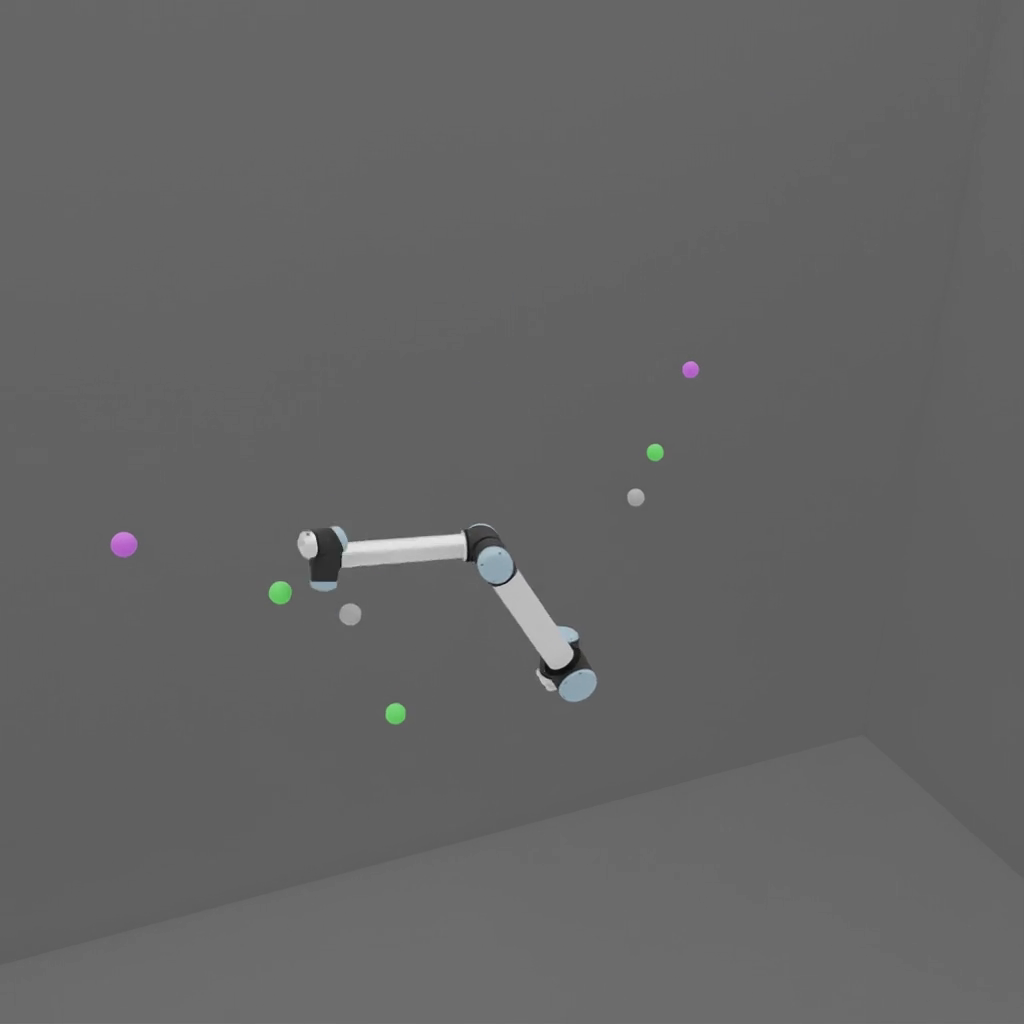
The robot moves to a series of end-effector target poses distributed around its workspace. At each pose, the end effector is close to the commanded position and orientation. On a passing run, the robot visibly reaches each target without obvious configuration-space discontinuities or joint limit violations.
Notes and Caveats#
This test applies to arm-like Cartesian kinematic chains, not standalone grippers. It also requires a Lula robot descriptor. Without a descriptor, the test skips. A skip is not a failure; it means the IK feature cannot be validated for this asset. To enable this test, register a Lula descriptor for the asset in the SimReady asset metadata.
This test is distinct from the jacobian_ik test. The jacobian_ik test uses an in-house damped-least-squares Jacobian solver that does not require a Lula descriptor and samples targets differently. Refer to the jacobian_ik doc for details.