

full_range_sweep (FET022 Driven Joints)#
Property |
Value |
|---|---|
Test name |
full_range_sweep |
Feature(s) |
FET_022_PHYSX, FET_022_NEWTON, FET_022_ISAAC |
Engine |
Kit / Isaac Sim (>=2024.2.0) |
Test version |
1.4.0 |
Summary#
Commands each non-passive, non-mimic-follower joint through its full authored range and confirms that the measured position tracks the commanded position at every waypoint.
What Pass Guarantees#
A passing result confirms that every non-passive, non-mimic-follower joint with authored limits reaches and holds both declared endpoints, returns to its zero position within the authored tolerance, and keeps the articulation stable throughout the sweep.
What It Checks#
The test drives each non-passive, non-mimic-follower joint individually from
its settled starting position through its full authored range. The sweep commands the joint to its maximum
limit, then to its minimum limit, and finally back to zero. At each waypoint, the
test measures the actual joint position and compares it to the commanded position.
A joint fails if it cannot reach and hold either commanded range endpoint within
rest_tolerance (default 0.10 rad) for most of the pause window, cannot return
to the zero position within the zero-return tolerance (default 0.01 rad), or if
its bounding box grows to more than 10 times its baseline size during the sweep
(bbox explode ratio, default 10). rest_check_fatal defaults to true; setting
it to false is reserved for explicitly diagnostic, non-conformance runs.
How It Works#
Each joint is swept in isolation. The test drives the joint to the upper limit at
a speed scaled by sweep_speed_scale (default 0.8), pauses for
pause_at_limits_seconds (default 0.15 s), then drives to the lower limit, pauses
again, and returns to zero. The baseline bounding box is captured before the sweep
begins. If the bounding box exceeds 10 times the baseline at any point, the test
immediately fails with a bbox-explode error, indicating the articulation has
become unstable or a prim has moved to an unexpected position.
Newton keeps the final zero target active until it remains within
zero_return_tolerance for newton_zero_consecutive_frames (default 8), up to
newton_zero_max_settling_seconds (default 2.0 s). This bounded convergence
check absorbs residual motion from the full-range reversal without changing the
verdict tolerance or accepting a single target crossing as settled.
Joints that have no authored lower and upper limits are skipped. Passive joints
and mimic-follower joints are excluded from the sweep; their behavior is covered
by other tests in this family. A direct target of a NewtonActuator is treated
as active even when the joint intentionally has no PhysicsDriveAPI. MuJoCo
tendon actuators are not converted into per-joint commands by this test.
Failure Cases#
Symptom |
Likely cause |
|---|---|
Joint cannot reach upper or lower limit |
Drive stiffness or maxForce too low; joint limited by collision geometry before the authored limit |
Joint cannot return to zero within tolerance |
Drive damping too low; residual energy keeps the joint oscillating |
Bounding box explode at a limit |
Articulation instability when joints reach their limits; physics solver divergence |
Rest-hold failure |
Drive stiffness or damping insufficient to hold the joint at the commanded limit position |
How to Fix#
If a joint cannot reach its authored limit, inspect the stiffness and maximum
effort on its UsdPhysicsDriveAPI or direct NewtonActuator, as applicable.
Confirm that collision geometry does not physically block the joint before the
authored limit is reached.
If the joint cannot return to zero, increase driveDamping to dissipate kinetic
energy, or reduce the sweep speed by lowering sweep_speed_scale.
If bounding box explosion occurs, check that the articulation tree is correctly rooted, that all joint bodies have valid mass and inertia values, and that the joint limits themselves are not set to physically impossible positions that cause solver instability.
Expected Result#
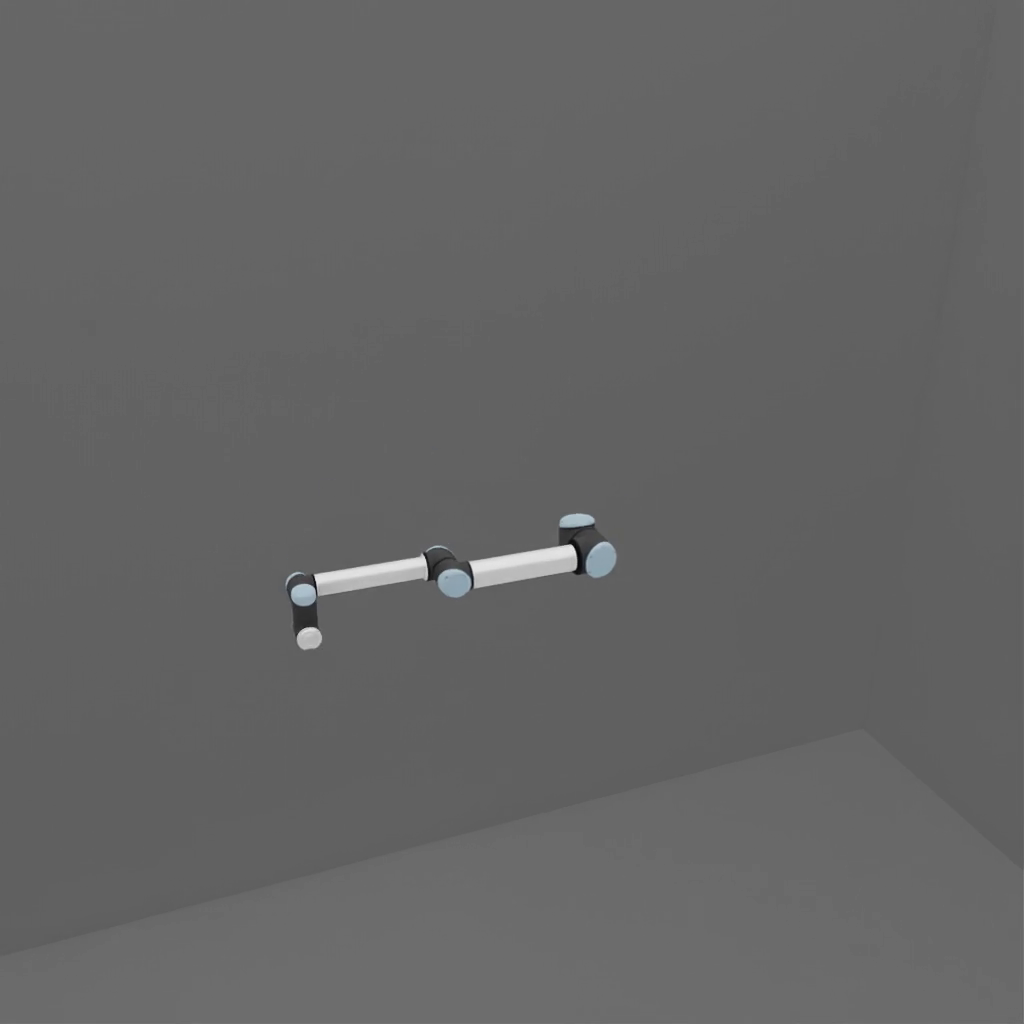
Each joint moves one at a time across its full range: to the upper limit, to the lower limit, and back to the rest position. The motion is smooth and continuous. No joint snaps, explodes, or fails to reach its waypoint. The articulation remains stable throughout.
Notes and Caveats#
The bbox-explode check uses the bounding box of the entire articulation, not of
the individual joint. A joint that is far from the base link can cause a large
bbox change even under normal motion; if the threshold triggers on a valid asset,
the bbox_explode_ratio config key can be raised.
Passive joints and mimic-follower joints are excluded from this test. Their range compliance is implied by the passive constraint definition and by the mimic-joint test, respectively.