

multi_joint_coordination (FET022 Driven Joints)#
Property |
Value |
|---|---|
Test name |
multi_joint_coordination |
Feature(s) |
FET_022_PHYSX, FET_022_NEWTON, FET_022_ISAAC |
Engine |
Kit / Isaac Sim (>=2024.2.0) |
Test version |
1.1.0 |
Summary#
Commands all non-passive, non-mimic-follower joints simultaneously to a target configuration and verifies that every joint reaches its target within tolerance and within the settling time limit.
What Pass Guarantees#
A passing result confirms that the drive controllers for all joints do not interfere with or stall each other during simultaneous motion. Reviewers, PMs, and OEMs can trust that the articulation can execute coordinated trajectories without joint-by-joint deadlock or oscillatory coupling between adjacent drives.
What It Checks#
The test commands all non-passive, non-mimic-follower joints simultaneously to
a target configuration. The target positions are computed as fractions of each
joint’s range (target factors: 0.3, 0.6, and 0.5 of the range, applied across
num_iterations (default 3) iterations). After each command, the test waits up
to max_settling_seconds (default 8.0 s) and then measures each joint’s
position. A joint fails if its position error exceeds position_tolerance_deg
(default 1 degree). If any joint fails in any iteration, the test fails. The
test skips when fewer than two joints with finite limits are found.
How It Works#
At each iteration, all drive targets are set simultaneously. The test then polls the articulation state at the simulation frame rate until either all joints are within tolerance or the settling timeout expires. The worst-case residual error is recorded for each joint. After the settling window closes, joints that have not converged are counted as failed.
The carrier fixture holds the robot base fixed throughout the test so that base drift does not inflate the per-joint position error.
Failure Cases#
Symptom |
Likely cause |
|---|---|
One joint fails to converge while others do |
Drive stiffness or maxForce too low on the failing joint; adjacent joints creating a reactive torque that the drive cannot overcome |
All joints fail to converge |
Drive gains globally insufficient for the articulation mass; maxForce limits too low across the board |
Joints converge individually but oscillate together |
Coupled dynamics between adjacent drives; damping values too low in the presence of inter-joint coupling |
How to Fix#
If specific joints fail to converge, increase driveStiffness and driveMaxForce
on those joints’ UsdPhysicsDriveAPI schemas. Verify that gravity compensation or
link mass values are physically correct, because an underestimated link mass can
make a joint appear to stall even with reasonable drive gains.
If oscillation occurs across multiple joints simultaneously, increase
driveDamping on all joints in the kinematic chain that connects the oscillating
links. Coupled oscillation often requires damping increases on multiple joints
rather than on only the joint that appears to be lagging.
Expected Result#
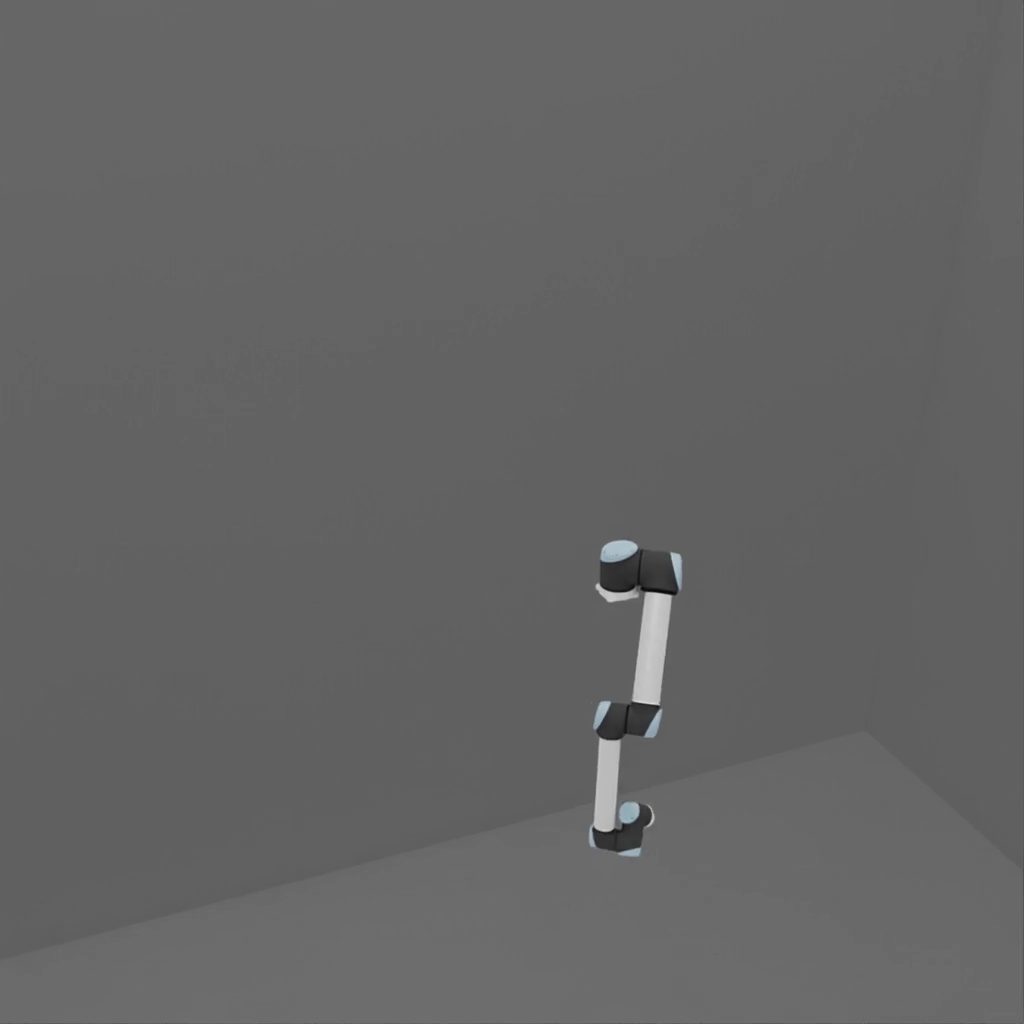
All robot joints move simultaneously toward a single target configuration. The motion looks fluid: joints accelerate and decelerate in concert rather than one at a time. The end effector smoothly reaches its target and holds. Joints stalling, jittering, or arriving at substantially different times indicates inadequate drive coordination.
Notes and Caveats#
The test skips when fewer than two joints with finite limits are present. A single joint cannot produce a meaningful coordination test, so the skip is expected behavior for simple articulations such as a single-axis gripper.
The tolerance is tighter than in the state-accuracy test (1 degree versus 5 degrees) because coordinated motion requires more precise convergence to avoid configuration-space drift accumulating over multiple simultaneous joints.