

state_accuracy (FET022 Driven Joints)#
Property |
Value |
|---|---|
Test name |
state_accuracy |
Feature(s) |
FET_022_PHYSX, FET_022_NEWTON, FET_022_ISAAC |
Engine |
Kit / Isaac Sim (>=2024.2.0) |
Test version |
1.2.0 |
Summary#
Commands each driven joint through a five-waypoint sequence and verifies that the reported joint position matches the commanded position within tolerance at each waypoint.
What Pass Guarantees#
A passing result confirms that the joint drive can hold a commanded position accurately and that the joint-state reporting is consistent with the physics simulation. Reviewers, PMs, and OEMs can trust that the position feedback published by the articulation is not offset, inverted, or noisy beyond the declared tolerance.
What It Checks#
The test commands each non-passive, non-mimic-follower joint through five
waypoints: the home position, a positive step, back to home, a negative step,
and back to home again. The step size is the smaller of max_step_deg (default
15 degrees) and step_range_fraction (default 10 percent) of the full joint
range. At each waypoint, after the joint has been given test_duration_seconds
(default 3.0 s) to settle, the actual position is measured and compared against
the commanded position. A joint fails if the position error at any waypoint
exceeds position_tolerance_deg (default 5 degrees). The test skips when no
testable joints are found.
How It Works#
Joints are tested in isolation. For each joint, the drive is commanded to each of the five waypoints in sequence. The test waits for the settling duration at each waypoint and then samples the current joint position from the articulation state. The absolute position error is computed and compared to the tolerance. If any waypoint error exceeds the tolerance, the joint is counted as failed, and the test fails.
Under Newton, the test uses the drives already authored by the asset and the
runtime’s GPU-backed articulation view for both target commands and state
readback. It does not add drives or rewrite their gains: the purpose of FET022
is to prove the asset’s own driven-joint behavior. Newton runs this tracking
check with zero scene gravity to isolate command accuracy from gravity
compensation. It also uses a minimum target ramp of
newton_min_motion_seconds (default 0.5 s). PhysX retains the original timing.
The slower Newton ramp avoids exciting solver-specific oscillation; waypoint
positions and the 5-degree verdict tolerance are identical on both engines.
Failure Cases#
Symptom |
Likely cause |
|---|---|
Position error exceeds 5 degrees at a waypoint |
Drive stiffness too low; joint drifts under gravity before settling time expires |
Error only on positive or negative step |
Joint limits asymmetric relative to home; drive exhibits asymmetric backlash or compliance |
Position error grows with each waypoint |
Accumulated drift; drive does not hold between commands |
How to Fix#
If position errors are consistently large, increase driveStiffness on the
joint’s UsdPhysicsDriveAPI schema to strengthen the restoring force toward the
commanded position. Verify driveMaxForce is high enough to deliver the required
torque, particularly for heavy links far from the base.
If errors are asymmetric, check whether the joint has an authoring offset or whether the rest position is not centered in the joint range. Correct the joint rest position so that positive and negative steps are symmetric about the commanded home position.
If drift accumulates over multiple waypoints, increase driveDamping to prevent
residual velocity from carrying the joint past each waypoint.
Expected Result#
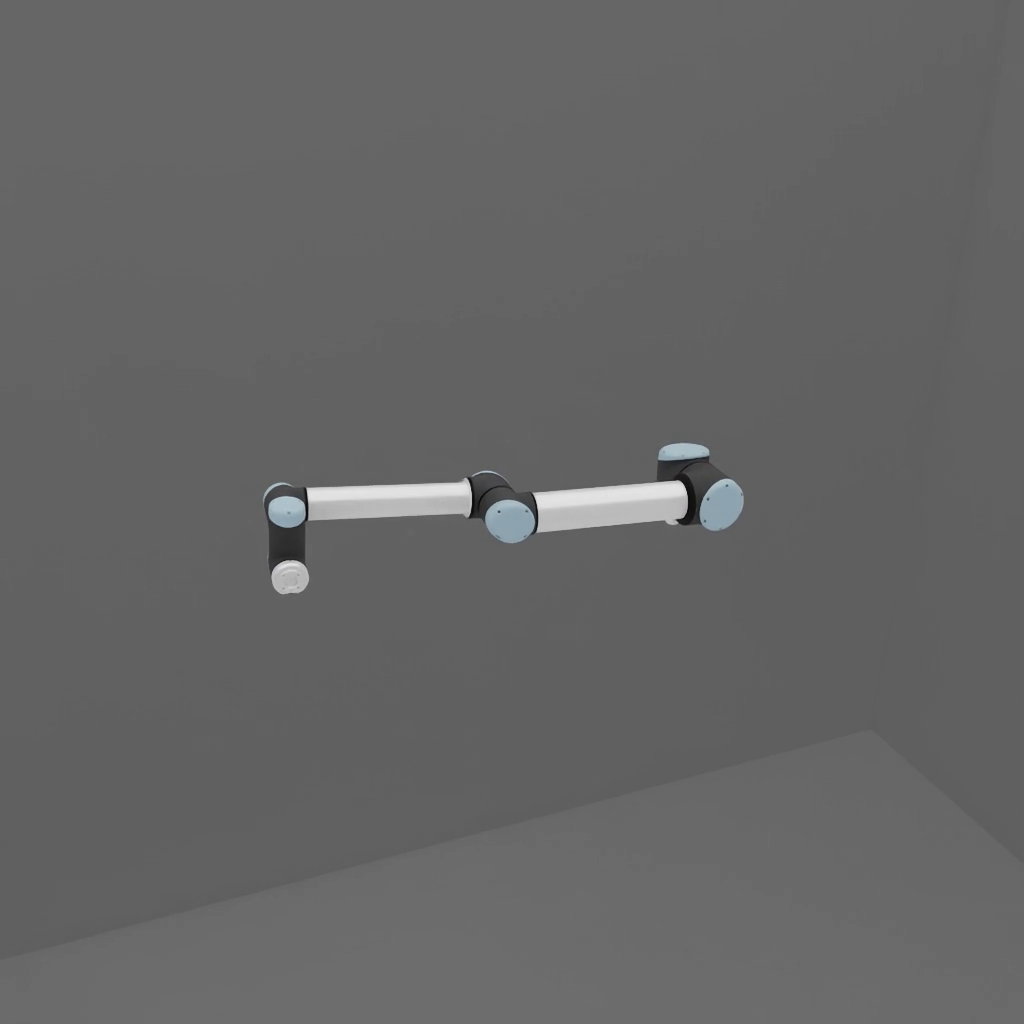
Each joint visits five waypoints in sequence: a small step outward, a return to the center, a small step in the opposite direction, and a final return to center. The joint settles visibly at each waypoint before moving on. Drift past the commanded position, oscillation, or failure to reach the target indicates inadequate drive stiffness or damping.
Notes and Caveats#
The test skips when no testable joints are found (all joints are passive, mimic followers, or have no finite limits). A skip result is not a failure.
The waypoint sequence is designed to exercise both the positive and negative direction of the drive and to confirm that the joint returns reproducibly to the home position. If the home position is not at zero, the test uses the actual commanded home value.
Newton uses the same nine-test FET022 family as PhysX/Isaac. Backend-specific operations use Newton tensor views and Newton-authored velocity and mimic contracts while the shared command/readback tests retain the same criteria.